By Nishant. Full article can be found here
What the Article Is About
This guide introduces the Model Context Protocol (MCP)—an open-source standard launched by Anthropic in late 2024. MCP makes it easy for AI agents (like chatbots) to connect securely and consistently with external tools and data sources—think file systems, APIs, databases—instead of reinventing custom integrations each time .
Why This Matters
Build smarter AI agents: MCP lets AI use real-time info (like docs or websites) to give better responses instead of relying only on pre-trained knowledge.
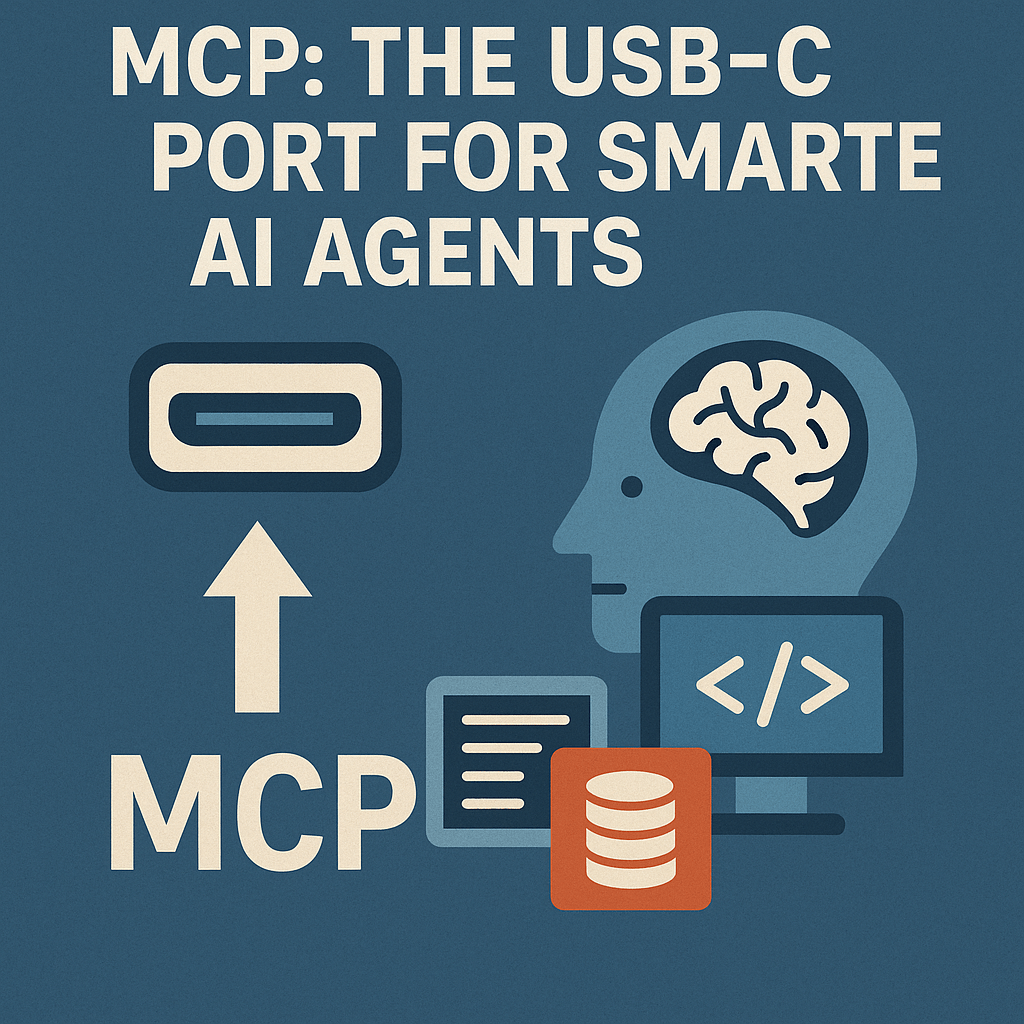
Standardized communication: Like USB‑C unifies device connections, MCP unifies how AI connects to tools—across OpenAI, Google DeepMind, and others.
Security and scalability: It supports safe, auditable access and helps large systems standardize integrations.
Key Takeaways
MCP defines a common format for tool access and context exchange between agents and data sources.
It supports client-server architecture: your AI is the client; each tool/data source runs as an MCP server.
Major platforms like OpenAI, DeepMind, Microsoft, and community frameworks now support or integrate MCP
Jargon Explained
JSON‑RPC 2.0 – A structured messaging format used by MCP to send requests and responses over the network.
MCP Server / Client – Server is the tool/data provider (like Google Drive); client is the AI layer that uses it.
Function calling – MCP builds on this idea to let AIs “call” real features, not just functions in their code.
What You Learn
MCP solves the “N×M” integration problem—no more repeating connectors for every AI‑tool pair.
It enables safe, context-rich AI—agents can perform tasks like file lookup, sending emails, or querying databases directly.
Security matters: tools need auditing, user consent, and limited permissions to minimize risks.
 Tech Teacher
Leave a comment